Applications
Built around continuity of care across settings
The same circuit reconfigures with the patient across the care pathway. Use in each setting is subject to local approved labelling, the Instructions for Use (IFU), staff training and local clinical protocols.
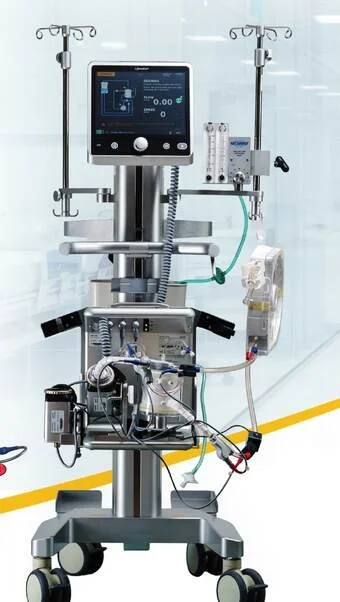 ICU
ICU
ECMO in the intensive care unit
Extracorporeal membrane oxygenation is an established intervention for severe cardiac and respiratory failure. The Lifemotion platform provides a complete ICU-configured system with integrated monitoring designed for extended, uninterrupted support over days to weeks.
- Continuous monitoring: three circuit pressures, differential pressure across oxygenator, flow, bubble detection, two temperature points
- Non-invasive venous SpO₂, haematocrit and haemoglobin on one display — no additional monitoring lines
- Layered pump-drive redundancy designed to reduce single points of failure during extended support
- Phosphorylcholine-coated blood-contacting surfaces across oxygenator, pump head and circuit
- Same continuous circuit reconfigures for retrieval — no circuit breakdown or rebuild if the patient needs to move
Outcome data: ELSO International Report 2022 (PMID 38181413); Victorian ECMO service 2016–22 (PMC11056431). Monitoring per Lifemotion manufacturer-published documentation. Data are population-level and do not predict individual outcomes.
 Emergency
Emergency ECMO & rapid deployment
Extracorporeal CPR (ECPR) — the application of VA ECMO during refractory cardiac arrest — is among the most time-critical interventions in emergency medicine. ELSO interim guidelines recommend ECMO flow be established within 60 minutes of cardiac arrest onset; benefit diminishes progressively beyond this window.
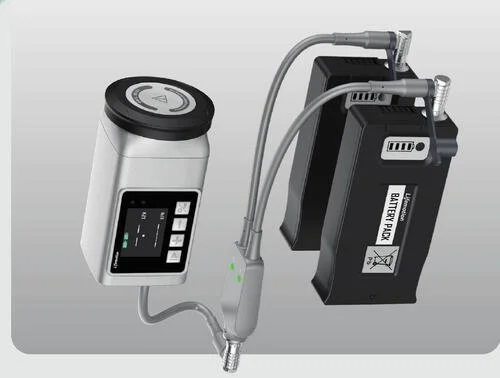
- Five-step guided priming sequence on touchscreen — designed to support fast, consistent setup under time pressure
- Real-time startup checklist for team coordination during cannulation
- Circuit monitoring active from first flow: pressures, bubble, temperature and SpO₂ on one display
- Battery-powered emergency pump backup — no hand cranking required during resuscitation
- Phosphorylcholine-coated blood path from initial circuit contact
ECPR evidence: ARREST Trial (Lancet 2020, phase 2, n=29, single-centre; interpret with caution) reported higher survival to discharge in the ECPR arm than in the standard-care arm. Prague OHCA (Belohlavek series); pooled analysis (Kim et al., eClinicalMedicine 2023, PIIS2589-5370(23)00165-7). ELSO all-comers ECPR registry survival 29.5%. ELSO ECPR Interim Guideline 2021. Priming workflow per Lifemotion manufacturer documentation.
 Transport
Retrieval & transport
Australia and New Zealand present some of the longest ECMO retrieval distances in the world. Victoria's centralised service documents retrievals up to 1,770 km; the NSW retrieval programme reports a median transport time of 5 hours 30 minutes. A systematic review of 2,647 adult ECMO transfers reported transport-related mortality of 0.15%.
- Same continuous circuit from referring ICU through every transport leg — no breakdown or rebuild at handover
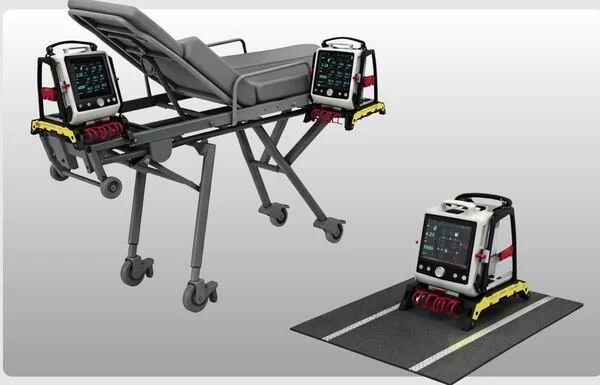
- Dual-battery configuration, up to 240 minutes published battery endurance; vehicle and aircraft power compatible
- Lightweight carbon-fibre support frame integrates pump driver, battery and disposables into a compact transport core
- Dedicated carrier system developed with Starmed GmbH — mounts securely to stretchers, ambulances and aircraft
- Full circuit monitoring during transport: pressures, flow, bubble, temperature and SpO₂
Transport safety: Mazur et al. systematic review, 22 studies (PMC7920709). NSW 9-year retrieval: Austin et al. 2018, Anaesthesia & Intensive Care (doi 10.1177/0310057X1804600608). Victorian service: PMC11056431. Battery endurance and transport config per Lifemotion manufacturer documentation; confirm against locally approved IFU. ELSO Transport & Retrieval Guideline 2022 (PMID 35184084).
Clinical context
Extracorporeal support as a therapy — published data
The figures below describe extracorporeal support as a therapy, from published registry and trial data. They are not Lifemotion outcome data.
Sources: Victorian ECMO service 2016–22 (PMC11056431); Austin et al. 2018, NSW 9-year retrieval series, Anaesthesia & Intensive Care (doi 10.1177/0310057X1804600608); Kim et al., eClinicalMedicine 2023, pooled ARREST + Prague analysis; Mazur et al. 2021 systematic review of 2,647 adult ECMO transfers (PMC7920709). Population-level data from published registry analyses and peer-reviewed literature; they do not predict individual outcomes and are not Lifemotion outcome data.
Phosphorylcholine coating: a biopassive surface throughout the circuit
Every blood-contacting surface in the Lifemotion circuit — membrane oxygenator, centrifugal pump head and ECMO sets — carries a consistent phosphorylcholine (PC) coating. PC is a zwitterionic phospholipid constituting the outer leaflet of the red blood cell membrane and the vascular endothelium. As a circuit coating it creates a biomimetic surface that reduces protein adsorption, platelet activation and adhesion, and complement activation — without relying on heparin as the active surface agent.
Published evidence includes a randomised controlled trial in high-risk cardiac surgery (Annals of Thoracic Surgery 2005) demonstrating better platelet preservation and lower postoperative bleeding in PC-coated vs heparin-coated circuits, and a 2024 systematic review naming PC coating as having "a major role in the improvement of biocompatibility, durability and antithrombogenicity of the circuit for ECMO" (PMC12194178). The pump head's PC surface contains no heparin — relevant for HIT-risk patients; systemic anticoagulation protocols per ELSO guidelines remain applicable.
PC coating evidence: Panzetta et al., Ann Thorac Surg 2005 (S0003-4975(05)01598-5); ECMO biocompatibility review PMC12194178, 2024. Lifemotion PC coating claim per manufacturer-published documentation. Published evidence covers PC coating class generally; no Lifemotion-specific clinical outcome data is available in the peer-reviewed literature at the time of writing (August 2026). Systemic anticoagulation per applicable ELSO guidelines.
 Request Demonstration →
Service Support →
Request Demonstration →
Service Support →