Extracorporeal cardiopulmonary resuscitation — ECPR — places demands on ECMO equipment that differ substantially from elective ICU use. The sequence is compressed. The environment is controlled chaos. And the margin for equipment complexity is essentially zero.
This checklist is designed for teams building or refining an ECPR programme in an Australian setting. It covers the equipment characteristics that matter most when minutes count, drawing on published ECPR literature and the locally approved specifications of ARTG-registered ECMO systems.
This content is for professional education. Refer to local clinical guidelines and the locally approved Instructions for Use.
Why ECPR changes the equipment equation
In planned ECMO — for a post-cardiotomy patient in ICU, or an elective respiratory case — setup time is counted in minutes and the team has the luxury of a controlled environment. ECPR is different: the window from arrest to ECMO support is measured against an evolving neurological injury clock, typically with the patient still receiving manual CPR when the circuit is being primed.
Every additional step in the setup sequence is a step taken under CPR. Every unnecessary connection is a connection made under pressure. Equipment that is efficient and predictable in a training scenario needs to remain so at 0200 on a Saturday.
Australian ECPR programmes — including those at several major cardiac arrest centres in Victoria, New South Wales and Queensland — have demonstrated that consistent, low-time-to-support outcomes are achievable. The equipment platform is a critical variable. See our Applications page for an overview of how the Lifemotion ECMO system is designed around continuity of care across ECPR, ICU and transport scenarios.
The ECPR equipment checklist
1. Console startup and guided workflow
What to look for: A console that provides a structured, step-by-step priming and startup sequence — not one that requires the operator to hold the full workflow in memory under resuscitation conditions.
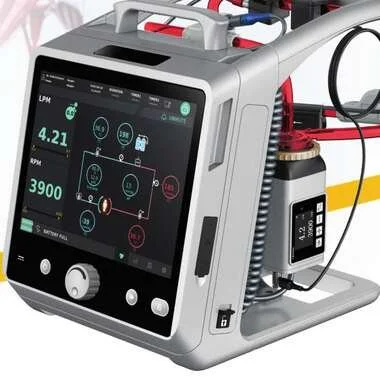
Why it matters in ECPR: The team member cannulating is rarely the same person driving the console. Guided workflows reduce reliance on individual expertise and support rapid onboarding of rotating team members. Confirm whether the console displays circuit pressure, flow and alarm conditions clearly, and whether the display is readable in a bright resuscitation bay as well as a low-light retrieval environment.
Check with your vendor: What is the manufacturer's documented priming time under standard conditions? Is there a guided priming mode? What happens to priming state if the console is accidentally powered off during setup?
2. Battery endurance and power independence
What to look for: Integrated battery with at least 90–120 minutes of run time at standard flow; published charge/depletion curves from the manufacturer; ability to run on vehicle and aircraft power for subsequent transport.
Why it matters in ECPR: ECPR patients who achieve ROSC (return of spontaneous circulation) often require inter-hospital transfer to a cardiac catheterisation laboratory or tertiary ECMO centre. The ECMO circuit may be running for the duration of cannulation, catheterisation and retrieval without a mains power connection. Confirm battery endurance against the locally approved Instructions for Use — do not rely on marketing specifications alone.
3. Circuit design: priming volume and biocompatibility
What to look for: Low priming volume circuit (reduces haemodilution on initiation); blood-contacting surfaces with a published biocompatibility treatment; single continuous circuit from cannulation through ICU admission.
Why it matters in ECPR: A lower priming volume means less crystalloid bolus on initiation and a faster time to full haemodynamic support. Biocompatible surface coatings — such as phosphorylcholine — are intended to reduce the systemic inflammatory response during extracorporeal circulation, which is particularly relevant in the already-compromised cardiac arrest patient. Confirm coating specification in the manufacturer's Instructions for Use.
The Lifemotion oxygenator (ARTG 528771) and centrifugal pump head (ARTG 528772) are both registered on the ARTG as components of the Lifemotion ECMO system. See Products for system specifications.
4. Cannulation support: what the console needs to provide
What to look for: Real-time flow and pressure monitoring visible during cannulation; alarm thresholds that alert to malpositioning or inadequate venous drainage; clear operator interface that does not require the team lead to leave the patient's side.
Why it matters in ECPR: Peripheral cannulation under CPR is a high-skill task. The console operator and the cannulating clinician need to communicate in real time. A console that requires the operator to navigate multiple menus during cannulation is a safety risk in this environment.
5. Mounting and rapid deployment kit
What to look for: A transport-ready mounting system (stretcher rail, trolley, backpack carrier or carbon-fibre frame) that allows the console to move with the patient from resuscitation bay to catheterisation laboratory to ICU without circuit disconnection.
Why it matters in ECPR: One of the highest-risk moments in ECPR is patient movement. A circuit that must be disconnected and re-primed on transfer significantly increases procedural risk. Purpose-built carrier systems — reviewed and, where relevant, aviation-certified — support continuous circuit integrity across all care settings.
6. ARTG registration status
What to look for: All components of the ECMO system (console, oxygenator, pump head, circuit sets) must be registered on the ARTG as medical devices before they can be legally supplied or used in Australia.
Why it matters in ECPR: In an emergency, the pressure to use whatever equipment is available is real. Clinical governance frameworks require that any device used in patient care holds current ARTG registration. Procurement teams should request ARTG numbers for each component, not just for the console.
The Lifemotion ECMO system holds four ARTG registrations covering the console (ARTG 528964), oxygenator (ARTG 528771), pump head (ARTG 528772) and circuit sets (ARTG 528773). These can be verified independently on the TGA ARTG database.
7. Training, simulation and team currency
What to look for: A vendor who provides on-site simulation and wet-lab training, not just paper-based product familiarisation; a structured competency pathway for all roles in the ECPR team (cannulating clinician, console operator, perfusionist or ECMO specialist, nursing lead); and a defined process for maintaining team currency between activations.
Why it matters in ECPR: ECPR activations are infrequent at most centres. Skill decay between activations is one of the most significant risks to a programme's reliability. Simulation — including full circuit setup, priming and simulated cannulation under CPR — is the most effective mitigation.
To discuss demonstration and training options for your centre, contact the OHM Healthcare Clinical Engineering team via our Contact page.
Building your ECPR programme: next steps
An ECPR programme requires alignment across cardiology, emergency medicine, intensive care, perfusion, clinical engineering, and hospital operations. The equipment platform is one component of that system — but it is the component that either enables or constrains every other part.
If your centre is evaluating ECMO systems for ECPR capability, OHM Healthcare provides system demonstrations, wet-lab sessions and clinical engineering consultation across Australia and New Zealand. The Lifemotion ECMO system is registered on the ARTG and supported locally by OHM Healthcare's Clinical Engineering team. Contact us to discuss a demonstration at your centre.
For healthcare professionals and healthcare organisations. Product availability and specifications subject to the locally approved Instructions for Use.

 Request Demonstration →
Service Support →