Lifemotion ECMO Console
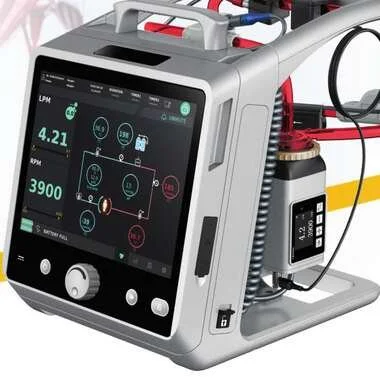
The console is the control centre of an ECMO circuit — driving the pump, monitoring the blood path and alarming on deviation. The Lifemotion ECMO Console (model LM-ECMO-1000, ARTG 528964) is built to make that control clear and consistent, at the bedside and on the move.
Touchscreen control with a guided workflow
A full-size touchscreen presents the circuit at a glance, with a real-time start-up checklist and a five-step guided priming sequence designed to help teams set up quickly and consistently — an advantage when a smaller retrieval team is working under time pressure.
Continuous circuit monitoring
The console continuously monitors the parameters clinicians rely on: three pressure points (with differential pressure calculated across the oxygenator), flow and bubble detection, two temperature points, and non-invasive oxygen saturation, haematocrit and haemoglobin — bringing the whole blood path into one clear display.
Designed to move with the patient
The console anchors a platform that reconfigures from a complete trolley-based system to a compact, self-contained transport core using the same circuit. With portable, dual-battery designs, it is built to keep running through the handovers of an ECMO retrieval and transport.
Part of a coordinated platform
The console works together with the disposable membrane oxygenator, centrifugal pump head and ECMO sets as one continuous circuit — not a set of separately-sourced parts.
ARTG-listed and locally supported
The Lifemotion ECMO Console is included on the Australian Register of Therapeutic Goods (ARTG 528964). OHM Healthcare, the exclusive Australia and New Zealand distributor, provides local clinical engineering — installation, commissioning, training and service.
Related reading: ECMO retrieval equipment: what transport teams need
For healthcare professionals. Specifications are drawn from Lifemotion's published product documentation and are subject to the locally approved instructions for use (IFU). Refer to the IFU for full details.
 Request Demonstration →
Service Support →
Request Demonstration →
Service Support →