Retrieving a patient already established on extracorporeal membrane oxygenation (ECMO) — or initiating support at a referring hospital and moving them to a tertiary centre — is one of the most demanding tasks in critical care. Australia and New Zealand’s geography makes it harder still: transfers can span hundreds of kilometres by road, rotary-wing and fixed-wing aircraft. The equipment a team carries has to keep a patient supported through every one of those handovers without interruption.
This guide outlines what a transport-capable ECMO configuration needs to include, and the practical considerations that separate bench-side hardware from a genuine retrieval platform.
Why transport ECMO is different
In the ICU, an ECMO circuit sits beside a stable power supply, wall gas and a full biomedical team. On retrieval, none of that is guaranteed. The same circuit has to move — between a bed, a trolley, an ambulance, a helicopter and an aircraft — while continuing to pump and oxygenate blood. The central principle is continuity: the fewer times a circuit has to be broken, re-primed or reconfigured during a transfer, the lower the risk to the patient and the workload on the team.
That principle drives every equipment decision below.
The transport equipment checklist
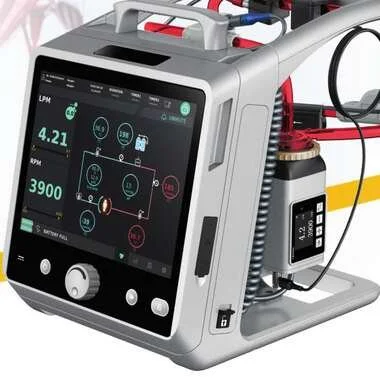
Portable, self-contained console — the console drives the pump, monitors the circuit and alarms on deviation. For retrieval it needs to run independently of mains power for the duration of a transfer, present its controls clearly in a moving, low-light environment, and be light enough to move safely between vehicles. A guided start-up and priming workflow helps a smaller team set up quickly under pressure.
Power and battery management — battery endurance determines how far a team can travel. Transport configurations typically use dual-battery designs plus the ability to charge from vehicle and aircraft power. Endurance and changeover procedures vary by system, so confirm them against the manufacturer’s published specifications and plan around worst-case journey time.
Oxygenator and gas supply — the membrane oxygenator performs gas exchange, so the plan must account for a reliable oxygen source and flow control for the entire journey, including margins for delays. Low resistance and stable performance over extended runs matter more on a long transfer than in a short bench test.
Pump head and circuit — a compact centrifugal pump head with a low priming volume reduces the blood-contact footprint and simplifies setup. Blood-contacting surfaces are commonly treated with a biocompatible coating intended to support haemocompatibility during extended circulation. The goal for transport is a single, continuous circuit that moves with the patient rather than being rebuilt at each handover.
Mounting and carrier systems — secure mounting to stretchers, ambulance rails and aircraft is essential for both patient safety and aviation compliance. Purpose-built carrier and frame systems let the console, pump and disposables travel as one restrained unit.
Monitoring and alarms — during transfer the team needs continuous visibility of flow, circuit pressures, and bubble and saturation detection, with alarms that are audible and visible over the noise and vibration of a moving vehicle.
Consumables and spares — a transport kit should carry the disposables and connectors a team might need mid-journey, matched to the specific system in use. There is no time to improvise a fitting at altitude.
Configuration, not just components
A retrieval platform is defined by how its parts work together. The most useful question is not what the individual specifications are, but how the configuration behaves across a full transfer chain — bed to trolley to ambulance to aircraft and back. Systems designed to reconfigure from a complete trolley-based platform down to a compact, self-contained transport core, using the same circuit throughout, reduce the number of high-risk transitions.
The local support factor
Transport equipment is only as reliable as the support behind it. In Australia and New Zealand, that means local clinical engineering: installation, commissioning, training for retrieval teams, and responsive service when a system needs attention. Distance amplifies the cost of downtime, so proximity of support is a legitimate part of any equipment decision, not an afterthought.
In summary
An ECMO retrieval configuration needs a portable console, dependable battery and power management, a reliable oxygenator and gas plan, a low-priming-volume pump and continuous circuit, secure mounting for road and air, clear monitoring, and a matched consumables kit — all backed by local clinical engineering support. Evaluated as a whole rather than as a parts list, that is what lets a team move a patient safely across the distances Australia and New Zealand transfers demand.
The Lifemotion ECMO platform is designed around exactly this continuity of care — reconfiguring from a complete trolley-based system to a portable transport core using one circuit, and supported locally by OHM Healthcare’s Clinical Engineering team across Australia and New Zealand. To arrange a technical walkthrough or demonstration, contact the OHM Healthcare team.
For healthcare professionals. Product configurations and specifications are subject to the locally approved instructions for use (IFU). Refer to the IFU for full details.

 Request Demonstration →
Service Support →
Request Demonstration →
Service Support →