This article is intended for healthcare professionals with training in ECMO management.
The centrifugal pump is the mechanical heart of an ECMO circuit. Understanding the physics that govern its behaviour helps explain clinical observations at the bedside — and underpins effective troubleshooting when flow is not what the team expects.
Afterload sensitivity: why centrifugal differs from roller pumps
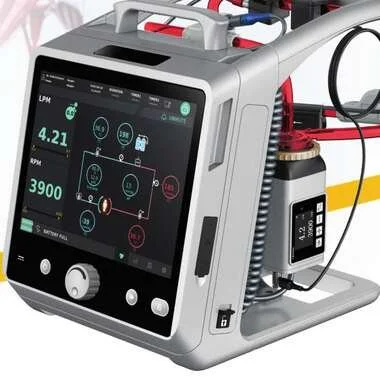
Unlike roller pumps, which deliver a fixed volume per revolution regardless of downstream conditions, centrifugal pumps are afterload-sensitive. The flow the pump generates is the net result of three variables: impeller speed (RPM), preload (the volume and pressure of blood entering the pump inlet), and downstream resistance.
This means the same RPM can produce significantly different flows depending on the patient's volume status and circuit resistance. Flow must always be directly measured — a flow monitor connected to the circuit — not assumed from impeller speed alone. A pump running at 3,000 RPM in a volume-depleted patient delivers considerably less flow than the same RPM in a euvolaemic patient.
Suction events
When preload falls significantly — due to hypovolaemia, pneumothorax, cannula malposition, or high negative pressure from excessive pump speed relative to venous return — the inlet cannula collapses cyclically against the vessel wall. This suction event is associated with haemolysis, circuit vibration, and high negative pressure alarms. Reducing pump speed while correcting the underlying cause is the standard response.
Magnetically driven designs
Modern ECMO centrifugal pumps use magnetic levitation or a magnetic bearing design rather than conventional mechanical bearings. The absence of a contact bearing eliminates a traditional failure mode, reduces heat generation, and improves the haemolysis profile during long-run support. Blood passes through the impeller with less mechanical shear than older bearing-driven designs.
Troubleshooting low flow
When unexplained low flow occurs, a systematic approach begins with:
Preload: is the drainage cannula filling adequately? Check volume status, cannula position, and venous drainage geometry.
Afterload: has downstream resistance increased? Check for circuit kinking, oxygenator clotting, or increased patient vascular resistance.
Circuit resistance: check for visible clot in the pump head or oxygenator.
Pump function: is the pump delivering expected flow for the given RPM, or is the relationship shifted?
Understanding the physics of the pump — that flow is a function of multiple variables, not simply of RPM — is the foundation of this assessment.
For information about the Lifemotion ECMO platform or to arrange a demonstration, contact OHM Healthcare at sales@ohmhealthcare.com.au or visit lifemotionecmo.com.au.
For healthcare professionals and healthcare organisations. Product availability and specifications subject to the locally approved Instructions for Use.
OHM Healthcare · sales@ohmhealthcare.com.au · 03 9115 7464 · lifemotionecmo.com.au

 Request Demonstration →
Service Support →