This article is intended for healthcare professionals with training in ECMO management.
Running ECMO at the bedside involves a continuous stream of monitored values. Interpreting them correctly requires understanding what each one actually reflects — and what it does not.
Pump flow (L/min)
Pump flow reflects the volume the circuit is moving per minute. It does not directly measure oxygen delivery to the patient.
Oxygen delivery depends on flow, haemoglobin concentration, and arterial oxygen saturation. In VA-ECMO, circuit flow is a component of total cardiac output — the patient's native cardiac output, if any, adds to circuit flow to determine total systemic oxygen delivery. Knowing circuit flow without knowing native cardiac contribution gives an incomplete picture of total perfusion.
Transmembrane pressure gradient (delta-P) across the oxygenator
Delta-P — the pressure difference between the blood inlet and outlet of the oxygenator — is one of the earliest and most reliable indicators of impending oxygenator clotting.
A rising delta-P at stable flow often precedes visible clot deposition or worsening post-oxygenator gas exchange by hours. Regular trend monitoring of delta-P, rather than point-in-time readings, is the most useful way to identify early oxygenator dysfunction in time for a planned circuit changeout rather than an emergency response.
Sweep gas flow rate
Sweep gas flow rate primarily controls CO2 clearance. CO2 is highly diffusible — it clears rapidly across the membrane oxygenator. This means patients can become profoundly hypocapnic if sweep flow is not carefully titrated relative to the patient's CO2 production.
In patients where cerebral perfusion autoregulation may be impaired — post-cardiac arrest being one context — hypocapnia-induced cerebral vasoconstriction carries clinical significance. Sweep gas management is not a background parameter.
Circuit temperature
The heat exchanger in the oxygenator can warm or cool. Targeted temperature management — whether for fever control or for planned cooling protocols — can be facilitated through circuit temperature. The clinical decision about temperature targets belongs to the clinical team; the circuit provides the tool.
Venous SpO2 and haematocrit/haemoglobin
Continuous venous SpO2 at the drainage cannula reflects the saturation of blood returning from the patient — a downstream indicator of the adequacy of oxygen delivery relative to consumption. A falling venous SpO2 at stable circuit flow suggests increased oxygen consumption or decreased oxygen delivery elsewhere.
Continuous haematocrit and haemoglobin values allow the team to monitor for haemolysis and to track the haemodilution effects of crystalloid administration or priming volume.
Integrated monitoring
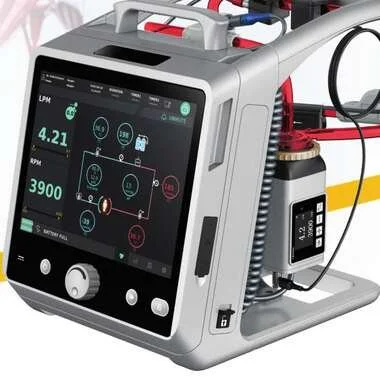
The Lifemotion ECMO console integrates all of these parameters on a single display — without additional monitoring lines. This is an engineering attribute of the platform.
For ECMO programme teams, the ability to review circuit pressures, delta-P, flow, venous SpO2, and haematocrit from a single console display — rather than correlating values across separate monitoring devices — simplifies the monitoring picture at the bedside.
Contact OHM Healthcare at sales@ohmhealthcare.com.au or visit lifemotionecmo.com.au for enquiries.
For healthcare professionals and healthcare organisations. Product availability and specifications subject to the locally approved Instructions for Use.
OHM Healthcare · sales@ohmhealthcare.com.au · 03 9115 7464 · lifemotionecmo.com.au

 Request Demonstration →
Service Support →