A pump failure during ECMO support is one of the scenarios an ECMO programme designs around. The question is not whether it has happened at other centres — it has — but whether the system your team depends on provides a credible response pathway when the primary drive fails.
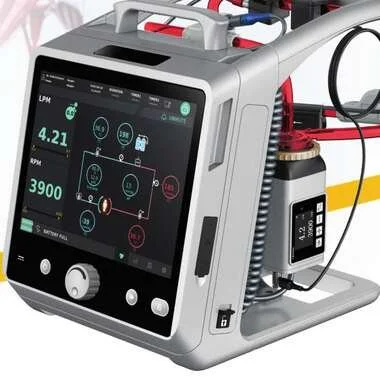
The Lifemotion ECMO system is built around a three-layer pump redundancy architecture.
Layer one: main centrifugal pump drive
The primary pump drive is a magnetically driven centrifugal pump — a standard design in contemporary ECMO platforms, favoured for its haemolysis profile, elimination of a mechanical bearing failure point, and established long-run performance. Pump speed, flow, and circuit pressures are displayed on the integrated console in real time.
Layer two: independently battery-powered backup motor
The backup motor is independently battery-powered — meaning its power supply is separate from the main drive. If the primary drive loses power or requires changeout, the backup motor can take over pump function without interrupting circuit flow. This is not a software failover; it is a physically independent mechanical drive.
Layer three: fully mechanical hand crank
The third layer is a fully mechanical hand crank. No electronics required. No battery required. If both powered drives are unavailable — in the most extreme scenario a programme might face — the hand crank maintains pump rotation, allowing the clinical team time to resolve the primary fault or initiate an emergency changeout.
One continuous circuit
The pump redundancy architecture works in concert with the circuit design: one continuous blood path that does not require breakdown or re-priming when reconfiguring from retrieval to ICU. The ARTG-registered circuit sets (ARTG 528773) are part of the same integrated system as the console (ARTG 528964), oxygenator (ARTG 528771), and pump head (ARTG 528772).
What these attributes describe
These are engineering attributes of the platform. They describe how the system is built, not an outcome for any individual patient. Clinical outcomes on ECMO depend on many factors beyond the device — patient selection, team expertise, programme design, and institutional governance among them.
For ECMO programme teams conducting a device evaluation, understanding how a platform approaches pump failure — and what options the clinical team has at each failure stage — is part of a responsible assessment process.
Demonstrations and wet-lab sessions
OHM Healthcare is scheduling demonstrations and wet-lab sessions with ECMO centres across Australia and New Zealand. Contact us at sales@ohmhealthcare.com.au or visit lifemotionecmo.com.au to arrange a session for your team.
For healthcare professionals and healthcare organisations. Product availability and specifications subject to the locally approved Instructions for Use.
OHM Healthcare · sales@ohmhealthcare.com.au · 03 9115 7464

 Request Demonstration →
Service Support →