This article is intended for healthcare professionals with training in ECMO management.
When a patient needs ECMO support and the nearest specialist centre is hundreds of kilometres away, the ECMO circuit does not stop at the hospital door.
Australia and New Zealand's geography presents one of the most demanding contexts for ECMO delivery in the world. Major ECMO centres are concentrated in capital cities. Regional and rural patients who need extracorporeal support face a time and distance problem that cannot be solved by simply having a capable ECMO programme in the nearest tertiary centre — that centre may be 500 kilometres away.
Retrieval ECMO — initiating or continuing ECMO support during inter-hospital transport — is the response to this problem. It is not a niche capability for ANZ. It is a core part of how the care pathway has to work.
The design requirements
For ECMO equipment to function reliably in a retrieval context, the design requirements are well-established:
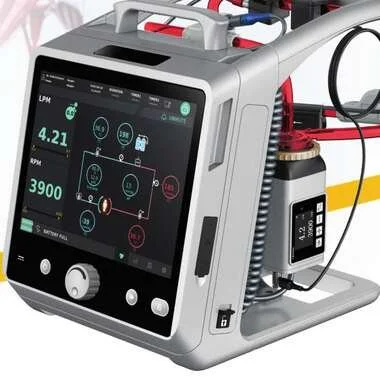
Power independence. Retrieval involves transition from hospital power to vehicle power to aircraft power, with connection and disconnection events at each transition. Dual independent batteries with meaningful endurance — the Lifemotion system provides dual batteries with up to 240 minutes published endurance (manufacturer figure) — provide the operational buffer a retrieval team needs.
Compact form factor. An ECMO system in a road ambulance, a fixed-wing aircraft, or a helicopter must fit within the physical and weight constraints of that environment. The transport system should be designed for these environments, not adapted from a bedside system.
Stable performance at variable orientation. Patient and equipment orientation change during road transport. The pump must maintain stable flow performance across the orientations encountered in the retrieval environment.
Integrated monitoring without hospital infrastructure. The monitoring capability available to the clinical team during transport should not depend on bedside monitoring equipment that cannot come with the patient. Integrated console monitoring — circuit pressures, flow, bubble detection, venous SpO2, haematocrit — reduces dependency on external monitoring during the transport phase.
ANZ-specific geography
The retrieval geography across Australia spans road ambulance (the majority of transfers by volume), fixed-wing jet (RFDS and state-based retrieval services covering longer distances), and helicopter. New Zealand adds island communities and challenging terrain.
For Pacific island communities — in Fiji, Papua New Guinea, and across Oceania — the retrieval distance to an ECMO-capable centre makes mobile ECMO capability the difference between access to care and no access.
OHM Healthcare's ANZ support
The Lifemotion ECMO system is the platform OHM Healthcare distributes for Australia and New Zealand. The transport architecture — the dedicated carrier system designed for aircraft and road ambulance use, developed with Starmed GmbH — reflects the retrieval context the system was designed for.
For retrieval service teams and ECMO centres with retrieval programmes, OHM Healthcare is glad to discuss the platform's transport capabilities in detail.
Contact OHM Healthcare at sales@ohmhealthcare.com.au or visit lifemotionecmo.com.au.
For healthcare professionals and healthcare organisations. Product availability and specifications subject to the locally approved Instructions for Use.
OHM Healthcare · sales@ohmhealthcare.com.au · 03 9115 7464 · lifemotionecmo.com.au

 Request Demonstration →
Service Support →